
HYTE MQ on Kubernetes
Messaging Platform-as-a-Service,
in your own Kubernetes clusters
HYTE MQ installs in your own Kubernetes clusters, on any distribution, in any public or private cloud. You control the platform. HYTE Console gives platform and application teams one place to view and manage event flows.
- Any Kubernetes distribution
- Public and private cloud
- Bare metal and virtual machines
Cloud vendor independence
Any cloud, anywhere
HYTE MQ works with any public or private cloud provider, with virtual machines, and with bare-metal infrastructure.
Kubernetes gives your organization one way to deploy messaging clusters in a single cloud provider or in several. Abstracting the provider keeps your messaging portable across cloud platforms.
- Multi-cloud environments
- Cloud vendor abstraction with Kubernetes
Kubernetes distributions
One Helm chart across cloud vendors
Helm chart deployments standardize HYTE MQ on Kubernetes from one cloud vendor to the next. You keep the ability to use each vendor's specific capabilities.
Bare metal and virtual machines
The HYTE MQ platform also runs without Kubernetes
- Public cloud virtual machines
- Private data center virtual machines
- On-premises bare metal
- IoT embedded compute
Interoperability
Kubernetes native
HYTE MQ is Kubernetes native and uses the best elements available within Kubernetes.
Benefits
- Runs in all types of compute environments
- Abstracts the public cloud vendor
Capabilities
- Configuration management
- Kubernetes Operator
- REST API
- Self-service console
Provisioning steps on Kubernetes
From a volume to a clustered, load-balanced HYTE MQ in five steps
Kubernetes brings a HYTE MQ cluster up in sequence. Configuration and clustering happen on their own.
-
1Volume added
-
2HYTE MQ container added
-
3HYTE MQ pods started
-
4HYTE MQ auto-configured and auto-clustered
-
5Load balancer provisioned
Operational best practices
Cluster connectivity that configures itself
HYTE MQ configures cluster connectivity during scaling, upgrades, and maintenance.
Scaling and upgrades
Brokers drain messages to their peers in the cluster during upgrades and scale-down, which keeps messages available.
Automatic clustering
Brokers in the same cluster connect on their own, and event flows configure across every broker in the cluster.
Security
HYTE MQ supports SSL certificate management, with optional use of cloud-vendor managed SSL certificates on load balancers.
Load balancers
A single web application reaches all brokers in a cluster and updates as Kubernetes scales the HYTE MQ cluster up and down.
Multi-tenancy
Run multiple event flows per HYTE MQ cluster, and multiple HYTE MQ clusters per Kubernetes cluster.
Multi-cluster connectivity
Connect across Kubernetes clusters for multi-cloud event flow redundancy.
Management
Self-service for the teams that own the applications
HYTE MQ gives users secured access to view and manage their own event flows.
The platform integrates with Kubernetes to automate processes and to give platform and application teams complete observability.
- Secure access to resources
- Delegate common tasks to application teams
- Support message management tasks
- Self-service API for automation
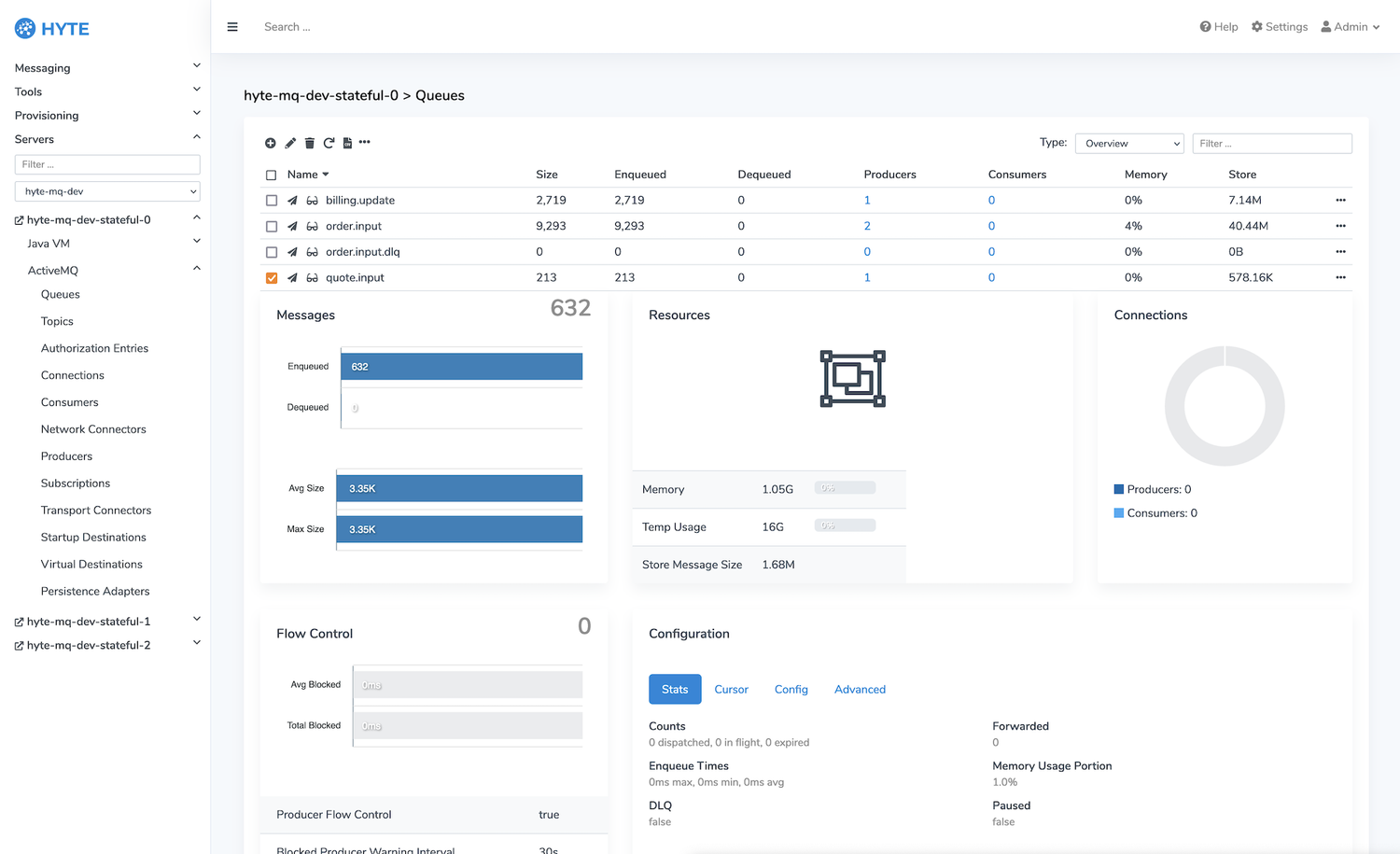
HYTE Console
One console for your enterprise messaging platforms
Many companies run multiple messaging platforms, with application and support teams around the globe. The Kubernetes-integrated HYTE Console lets you view and manage them in one centralized application.
- Modern web UI
- Secured access to designated queues and topics for application teams
- Sensible default templates
- Customized security access (IAM)
- Active Directory and LDAP integration
HYTE API
Every console function, available over REST
HYTE Console management and messaging data services are available through a REST API, so teams can automate messaging administration and testing tasks. Built-in rate limits control the flow of API requests.
- REST-based access to all functions
- The same secured access as HYTE Console
- Application teams automate production tasks
- DevOps teams run CI/CD tasks
Protocols and clients
Connect with the protocol your application already speaks
HYTE MQ is based on Apache ActiveMQ, which speaks open, standard messaging protocols. Application teams connect with standard client libraries in the language they already use.
Java services and enterprise applications
Java, plus native C# client libraries
Services written in different languages, and cloud integration
Java, .NET, Python, Go, JavaScript
Devices, registers, and edge applications
Go, JavaScript, Python, C
Scripts and lightweight tools
Scripting languages
Browser and mobile front ends
JavaScript, over MQTT or STOMP
Use cases
Any event flow, in one cloud or across several
HYTE MQ supports all event flows, including multi-cloud and cross-cloud.
Event-driven applications
Event-driven design gives complex applications scalability, modularity, and asynchronous task execution.
Multi-cloud connectivity
Share data across cloud zones and regions, so applications in different areas reach the same events.
Messaging as a service
Integrating applications and systems requires dependable delivery of messages and events between them. Your platform team offers that to every application team from one shared platform.
Migration paths
Start from where you are
Few teams begin with an empty cluster. HYTE has a path in from the messaging you run today.
From IBM MQ
Standard messaging protocols and APIs turn most code conversion into configuration, rebuilding, and retesting. HYTE MQ integrates with IBM MQ clustering, so both run side by side while you move at your own pace.
See the IBM MQ migration pathFrom ActiveMQ on virtual machines
HYTE MQ moves between virtual machines, bare metal, and containers without changes to application code, so administrators can shift runtimes onto Kubernetes without pulling in development teams.
Read about HYTE MQFrom a mix of messaging products
HYTE Link bridges messaging products from multiple vendors and protocols, and HYTE Console manages them in one place while the transition runs.
Read about HYTE LinkHYTE Support
Support from engineers who work on the broker itself
HYTE supports integration technologies and nothing else, so the engineer on your case is a messaging specialist. Our engineers commit code upstream to Apache ActiveMQ, and HYTE delivers patches and contributes fixes back to the community.
Choose around-the-clock or business-hours coverage to match when your business needs it.
Explore HYTE SupportEvery support package includes
- Unlimited support cases
- All of your ActiveMQ environments
- Sample code for development questions
- Architecture reviews with a tenured architect
- Quarterly reviews of recent cases and planning
Get started
From Helm chart to running cluster
HYTE MQ installs with the tools your platform team already uses.
- A Kubernetes cluster, on any distribution
- Helm
- Persistent storage for broker volumes
# Add the HYTE chart repository
$ helm repo add hyte $HYTE_CHART_REPO

# Install a HYTE MQ cluster into your namespace
$ helm install $RELEASE hyte/<chart> \
    --namespace $NAMESPACE --values values.yaml

# Watch the brokers start and join the cluster
$ kubectl get pods --namespace $NAMESPACE --watch
Questions?
Talk it through with a Messaging Platform Architect
A short conversation can make it all clear. Schedule a quick discussion or an online demo of the platform and tools.
Frequently Asked Questions
What is HYTE MQ on Kubernetes?
HYTE MQ is an enterprise messaging platform based on Apache ActiveMQ. On Kubernetes, HYTE MQ installs in your own clusters through Helm charts and works with any Kubernetes distribution in public or private clouds. HYTE Console gives platform and application teams one place to view and manage event flows.
Which clouds and Kubernetes distributions does HYTE MQ support?
HYTE MQ works with any Kubernetes distribution and with any public or private cloud provider. Helm chart deployments standardize the installation across cloud vendors, and you keep the ability to use each vendor's specific capabilities.
Can HYTE MQ run without Kubernetes?
Yes. The HYTE MQ platform also runs on bare metal and virtual machines. That includes public cloud virtual machines, private data center virtual machines, on-premises bare metal, and IoT embedded compute.
How does HYTE MQ handle scaling and upgrades on Kubernetes?
HYTE MQ configures cluster connectivity during scaling, upgrades, and maintenance. Brokers drain messages to their peers in the cluster during upgrades and scale-down, which keeps messages available. Brokers in the same cluster connect on their own, and the load balancer updates as Kubernetes scales the HYTE MQ cluster up and down.
Can application teams manage their own queues and topics?
Yes. HYTE Console gives application teams secured access to their designated queues and topics, with customized security access and Active Directory and LDAP integration. The same functions are available through a REST API, so teams can automate production tasks and CI/CD work.
Which messaging protocols and client languages does HYTE MQ support?
HYTE MQ is based on Apache ActiveMQ and speaks open, standard messaging protocols: OpenWire with Jakarta Messaging (JMS), AMQP 1.0, MQTT, STOMP, and WebSocket. Application teams connect with standard client libraries in the language they already use, including Java, C#, Python, Go, and JavaScript.
What support does HYTE offer for HYTE MQ on Kubernetes?
HYTE Support comes in around-the-clock and business-hours packages. Every package includes unlimited support cases across all of your ActiveMQ environments, sample code for development questions, architecture reviews with a tenured architect, and quarterly reviews. HYTE supports integration technologies and nothing else, and its engineers commit code upstream to Apache ActiveMQ.
Apache, ActiveMQ, and Apache ActiveMQ are trademarks of The Apache Software Foundation. HYTE is an independent contributor, not affiliated with or endorsed by the ASF. IBM and IBM MQ are trademarks of International Business Machines Corporation. Kubernetes and Helm are registered trademarks of The Linux Foundation. The AWS, Microsoft Azure, Google Cloud, and DigitalOcean names and logos belong to their respective owners and appear here only to identify platforms where HYTE MQ runs. No endorsement is implied.